Introduction
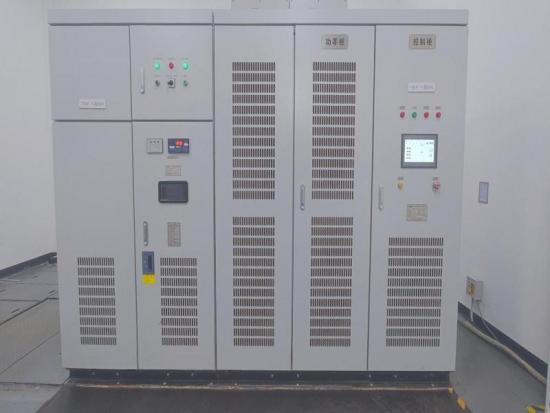
STATCOM (Static Synchronous Compensator)
is a power electronics-based device used in electrical power systems to
provide fast-acting reactive power compensation, voltage regulation, and
stability enhancement. It is a member of the Flexible AC Transmission
System (FACTS) family and is widely used in modern power grids to improve
power quality and system efficiency.
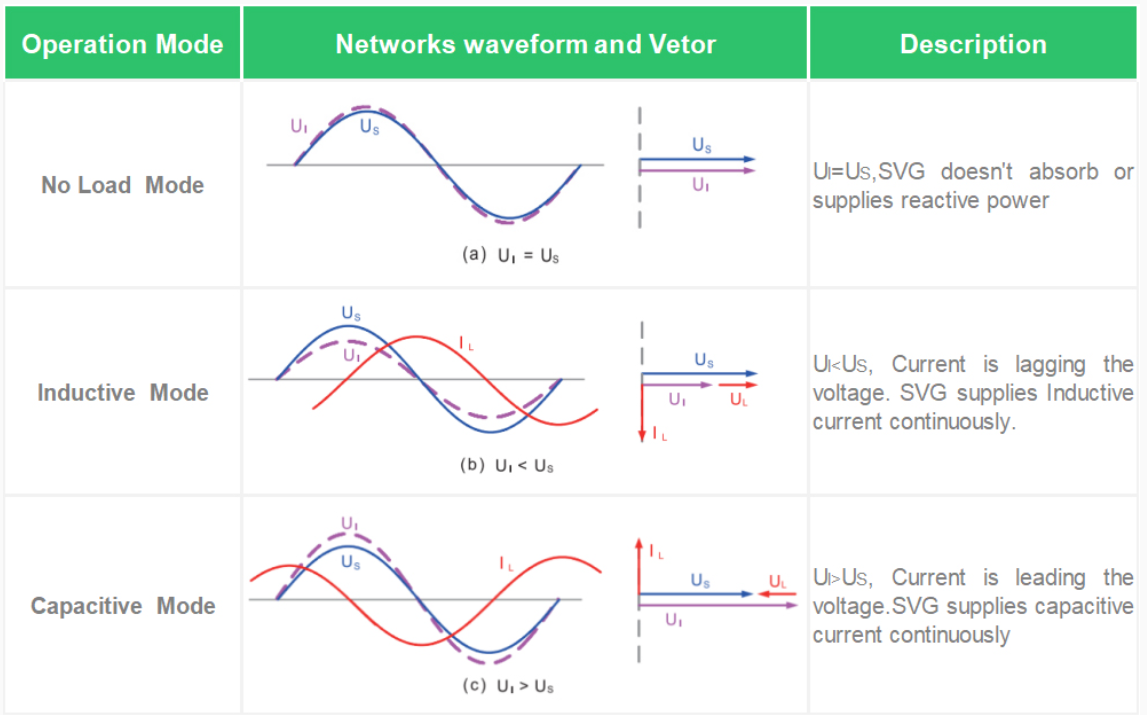
- A STATCOM consists of a Voltage-Source Converter (VSC), a DC
capacitor, and a coupling transformer. - The VSC generates an AC voltage in phase with the grid but with
adjustable magnitude.- If the output voltage is higher than the grid voltage, it
injects capacitive reactive power (leading). - If the output voltage is lower, it absorbs inductive reactive
power (lagging).
- If the output voltage is higher than the grid voltage, it
- The DC capacitor provides the necessary energy storage for the
converter.
Key Features of STATCOM
- Reactive Power Compensation
- Generates or absorbs reactive power (VARs) dynamically to
maintain voltage stability. - Unlike traditional SVCs (Static VAR Compensators), STATCOMs
use voltage-source converters (VSCs) for smoother and faster
response.
- Generates or absorbs reactive power (VARs) dynamically to
- Voltage Regulation
- Maintains bus voltage at a desired level by injecting or
absorbing reactive power. - Helps mitigate voltage sags, swells, and flicker.
- Maintains bus voltage at a desired level by injecting or
- Dynamic Performance
- Faster response compared to mechanical switches and
thyristor-based compensators (response time in milliseconds). - Effective in damping power oscillations and improving
transient stability.
- Faster response compared to mechanical switches and
- No Need for Large Capacitors/Reactors
- Uses DC capacitors and power electronics (IGBTs/GTOs) instead of bulky passive components.
- Black Start Capability
- Some STATCOMs can help restore power in case of a blackout by providing reactive power support
Advantages of STATCOM Over SVC (Static VAR Compensator)
STATCOMs (Static Synchronous Compensators) and SVCs (Static VAR Compensators)
both provide reactive power compensation, but STATCOMs
offer superior performance in modern power systems. Below is a detailed comparison:
1. Faster Dynamic Response
| Device | Response Time | Implications |
|---|---|---|
| STATCOM | < 1 cycle (5–10 ms) | Better for transient stability, flicker mitigation, and rapid voltage control. |
| SVC (TCR/TSC) | 2–4 cycles (40–100 ms) | Slower due to thyristor switching delays. |
☑ STATCOM wins → Essential for wind/solar farms, HVDC links,
and weak grids needing ultra-fast corrections.
2. Better Low-Voltage Performance
| Device | Behavior During Voltage Dips |
|---|---|
| STATCOM | Maintains full reactive current even at very low voltages (down to 0.2 pu). |
| SVC (TCR/TSC) | Reactive power output drops with voltage² (P = V²/X). |
☑ STATCOM wins → Critical for fault ride-through (FRT)
in renewables and preventing blackouts.
3. Smaller Footprint & No Passive Components
| Device | Components | Space Requirement |
|---|---|---|
| STATCOM | Voltage-Source Converter (VSC) + DC capacitor | Compact (30–50% smaller than SVC). |
| SVC (TCR/TSC) | Thyristor-controlled reactors (TCR) + capacitor banks | Bulky (large reactors & capacitor banks needed). |
☑ STATCOM wins → Ideal for urban substations,
offshore platforms, and mobile installations.
4. Lower Harmonics & No Resonance Risk
| Device | Harmonic Generation | Filter Requirements |
|---|---|---|
| STATCOM | Low (PWM-controlled, <3% THD) | Minimal filtering needed. |
| SVC (TCR/TSC) | High (5th, 7th harmonics) | Requires bulky filters. |
☑ STATCOM wins → Reduces filter costs and avoids
resonance issues with grid impedance.
5. No Need for Step-Up Transformers (in some cases)
- STATCOM can be designed for direct medium-voltage (MV) connection (e.g., 11–33 kV).
- SVC often requires additional step-up transformers for MV/HV grids.
☑ STATCOM wins → Lower equipment costs & losses.
6. Bidirectional Reactive Power (No Switching Lag)
| Device | Reactive Power Transition |
|---|---|
| STATCOM | Seamless (continuous control) – No delay between capacitive/inductive modes. |
| SVC (TCR/TSC) | Step-wise (TSC switching delays) – Limited by capacitor bank sizes. |
☑ STATCOM wins → Smoother voltage regulation & better grid stability.
7. Higher Efficiency at Partial Loads
- STATCOM has lower losses (~1–2%) compared to SVC (2–4%), especially at low loads.
- SVC suffers from fixed reactor losses even when idle.
☑ STATCOM wins → Better for energy savings in variable-load systems.
Data Sheet
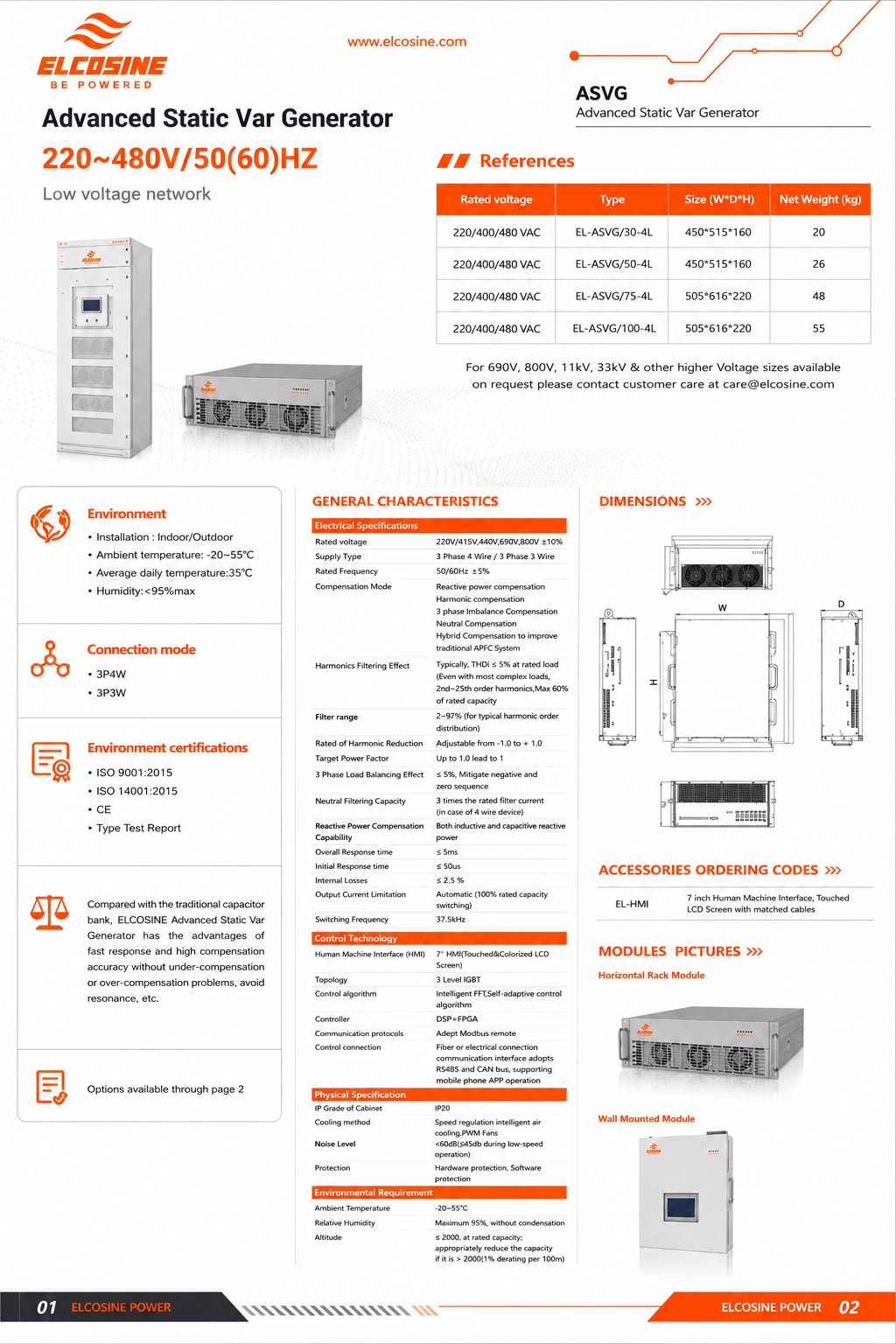
Here are the detailed technical specifications for a 11kV STATCOM system,
covering key parameters required for procurement, design, and deployment.
Technical Specifications
General Parameters
| Parameters | Specifications |
|---|---|
| Rated Voltage | 6.6kV ±10% |
| Rated Reactive Power (Single Device) | ±1 MVAr ~ ±15 MVAr |
| Response Time | ≤ 10 ms |
| Cooling System | Air-cooled or Liquid-cooled System |
| Control Modes | Voltage Regulation, PF Correction, VAR Control |
| Communication Protocol | IEC 61850, Modbus, DNP3, SCADA Integration |
Electrical Characteristics
| Voltage Operation Range | 0.8 pu to 1.2 pu |
| Frequency Range | 47–52 Hz or 57–62 Hz |
| Harmonic Distortion (THD) | <3% (IEEE 519 Compliant) |
| Overload Capacity | 1.1 × Continuous Operation (Alarm after 3 min) 1.2 × Operation for 1 minute 1.3 × Instantaneous Trip |
Mechanical Design
| Enclosure | Indoor Type or Outdoor Containerized Type |
| IP Rating | IP30 (Indoor), IP54 (Outdoor) |
| Cooling System | Air-cooled or Liquid-cooled System |
Protection & Safety Features
| Overcurrent, Overvoltage and Undervoltage Protection |
| Short-Circuit Withstand Capability (1 sec) |
| Redundant Control System (N+1 Configuration) |
| Fire Suppression System (For Liquid-Cooled Units) |
Control System
| Digital Controller (DSP / FPGA Based) |
| Real-Time Monitoring (Voltage, Current, VAR Flow) |
| Auto-Tuning Algorithms for Dynamic Response |
Auxiliary Power Supply
| 400 Vac, 220 Vdc, 110 Vdc |
Application of a 6.6kV, ±10MVAr STATCOM in Coal Mining
Coal mining operations rely on large motors, crushers, and conveyors,
which cause voltage fluctuations, harmonic distortion, and poor power
factor. A 6.6kV STATCOM provides dynamic reactive power compensation,
ensuring stable power quality and reducing equipment stress.
1. Key Power Quality Issues in Coal Mines
A. Voltage Dips & Flicker
- Cause: Sudden starts/stops of haulage motors, crushers.
- Effect: Flickering lights, tripping of sensitive equipment.
B. Poor Power Factor (0.6–0.8 Lagging)
- Cause: Induction motors, transformers, and long cables.
- Effect: Utility penalties, higher energy losses.
C. Harmonics (5th, 7th, 11th Order)
- Cause: Variable Frequency Drives (VFDs), rectifiers.
- Effect: Overheating and premature motor failure.
D. Voltage Unbalance
- Cause: Uneven loading of 3-phase systems.
- Effect: Motor vibration and reduced efficiency.
2. How a 6.6kV STATCOM Solves These Issues
A. Instantaneous Voltage Stabilization
- Reactive power injection/absorption in <10ms to smooth voltage dips.
- Reduces motor stalling during conveyor belt startups.
B. Dynamic Power Factor Correction
- Maintains PF ≥ 0.95, avoiding utility penalties.
C. Active Harmonic Filtering (Optional)
- Some STATCOMs include selective harmonic compensation (up to 25th order).
D. Load Balancing
- Compensates for uneven phase currents, improving motor life.
3. Typical 6.6kV STATCOM Configuration for Coal Mines
| Parameter | Specification |
|---|---|
| Voltage Level | 6.6kV (Connected at Mine Substation) |
| Reactive Power | ±15MVAr (Adjustable Based on Load) |
| Response Time | <10ms |
| Cooling | Liquid-Cooled (For Harsh Mining Environments) |
| Control System | Real-Time DSP + SCADA Integration |
| Protection | Overcurrent, Overvoltage, Thermal Monitoring |
4. Benefits of STATCOM in Coal Mining
- ✓ Smoother motor operation (reduced mechanical stress).
- ✓ Eliminates power factor penalties (saves significant operating costs).
- ✓ Extends equipment lifespan (motors, transformers, conveyors).
- ✓ Complies with IEEE 519 and IEC 61000-3-6 harmonic standards.