Textile
Overview
With the continuous advancement of automation and intelligent manufacturing in the textile and garment industry, a wide range of automatic control systems and power electronic equipment have been deployed across production lines. From spinning to weaving, numerous variable frequency drives (VFDs) and speed control devices are used, which while improving productivity, also create significant power quality challenges.
Common issues include:
Automatic control failures in equipment such as nylon slice production lines, sizing machines, doubling machines, automatic winders, combers, blow-carding machines, and twisters
Temperature control malfunctions caused by harmonic interference, leading to unstable production conditions
Product quality degradation, resulting in substantial economic losses
Overheating of transformers, busbars, and electrical components in the power distribution system, creating hidden safety risks
Adopted Solution
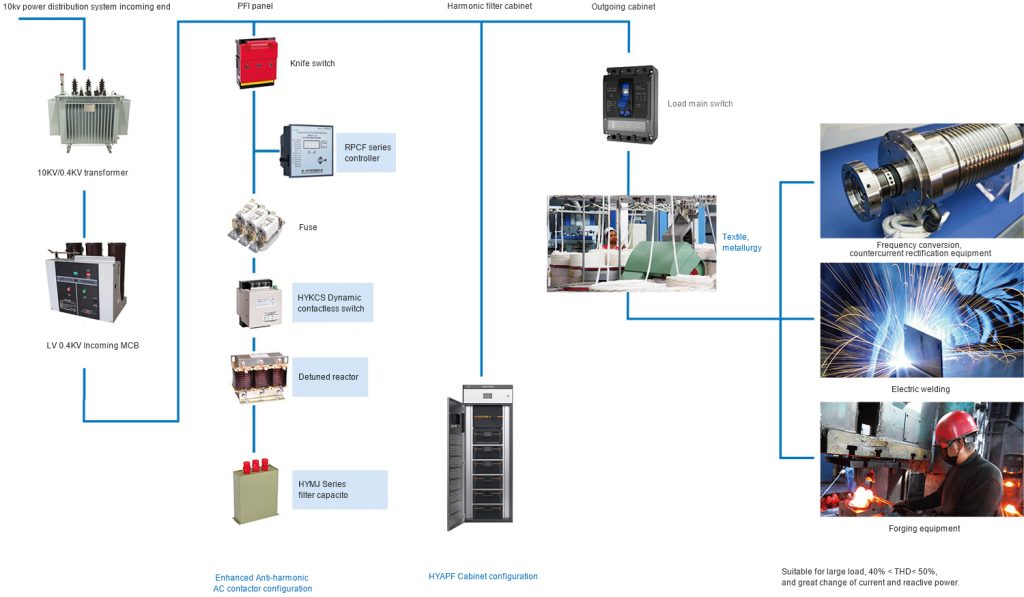
To address these challenges, Elcosine Power deployed advanced Dynamic Contactless Switching Technology combined with harmonic mitigation solutions:
Dynamic Contactless Switch Technology
Utilized for capacitor switching panels, ensuring no inrush current, no oscillation, and ultra-fast response, thus enhancing stability and reliability.Active Power Filter (APF) Devices
Effectively filter out harmonics, bringing total harmonic distortion within national standard limits.
Achieved Results
Power Factor Improvement: Average power factor raised to 0.98 and above
Harmonic Suppression: All harmonics effectively filtered, ensuring stable operation of sensitive textile equipment
Energy Savings: Reduced transformer heating and line losses, lowering operational costs
Enhanced Reliability: Lower failure rates of electrical components and production equipment, ensuring continuous high-quality output
By implementing Elcosine Power’s solutions, textile enterprises achieve greater efficiency, reduced downtime, improved product quality, and enhanced system safety, while ensuring long-term sustainable operations.
Scheme drawing reference