Ship and automobile manufacturing
Overview
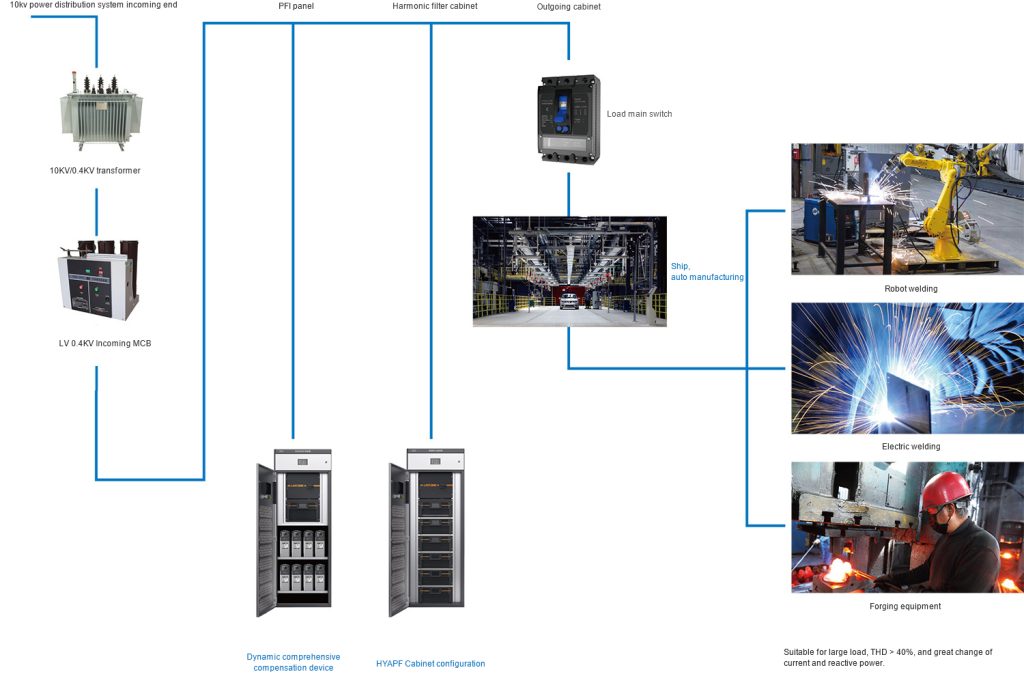
In automobile production workshops such as pressing, welding, and assembly workshops, the use of numerous non-linear loads — including electric welding machines, laser welding machines, and large-capacity motors — results in significant power quality issues.
The transformer load currents in these workshops exhibit severe harmonic distortion, primarily in the 3rd, 5th, 7th, 9th, and 11th orders. On the 400 V low-voltage bus, the total voltage distortion rate exceeds 5%, while the total current distortion rate (THD) reaches nearly 40%, far beyond acceptable standards.
This leads to:
Excessive harmonic power losses in electrical equipment and transformers
Increased transformer heating and efficiency losses
Average transformer power factor as low as 0.6, causing serious power loss and reduced output active power capacity
Harmonic interference disrupting the automatic Fieldbus control system, preventing normal production operations
Adopted Solution
To resolve these issues, Elcosine Power recommends deploying a combination of Intelligent Power Quality Comprehensive Management Devices (SVG/APFC) along with Active Power Filters (APF). These solutions provide:
Reactive Power Compensation: Rapid and accurate compensation, improving average power factor to 0.98 and above
Harmonic Mitigation: Effective filtering of harmonic currents in compliance with national and international standards
Energy Savings: Reduced transformer and line losses, lowering overall power consumption
System Reliability: Improved transformer utilization, reduced overheating, and extended lifespan of electrical components
Operational Stability: Eliminating harmonic interference ensures uninterrupted operation of automated production systems
With Elcosine’s advanced solutions, automobile manufacturing workshops achieve higher energy efficiency, reduced operational costs, and enhanced production reliability.
Scheme drawing reference