Rail
Overview
In rail transit traction power supply systems, rectifier units are widely used to provide DC power for EMUs. This inevitably generates harmonics, and when harmonic levels exceed permissible limits, they pose significant risks to both the urban power grid and the railway system itself.
Additional sources of harmonics in rail transit include lighting systems, UPS devices, elevators, and fans, which commonly produce 3rd, 5th, 7th, 11th, and 13th order harmonics. Given the large load demand and significant reactive power requirements, these harmonics severely impact power quality.
Key Challenges
Relay & Automation Failures: Harmonics interfere with relay protection and automatic devices, risking system malfunction or refusal to operate.
Equipment Losses & Damage: Electrical devices experience extra losses, overheating, vibration, and noise, reducing lifespan and reliability.
Transformer Losses: Excessive harmonics and reactive power increase transformer heating, reduce efficiency, and propagate harmonic pollution to the high-voltage grid, magnifying large-scale power quality issues.
Voltage Distortion: Harmonic currents from auxiliary loads (lighting, UPS, fans, elevators) distort supply voltage, creating unstable conditions.
Adopted Solution
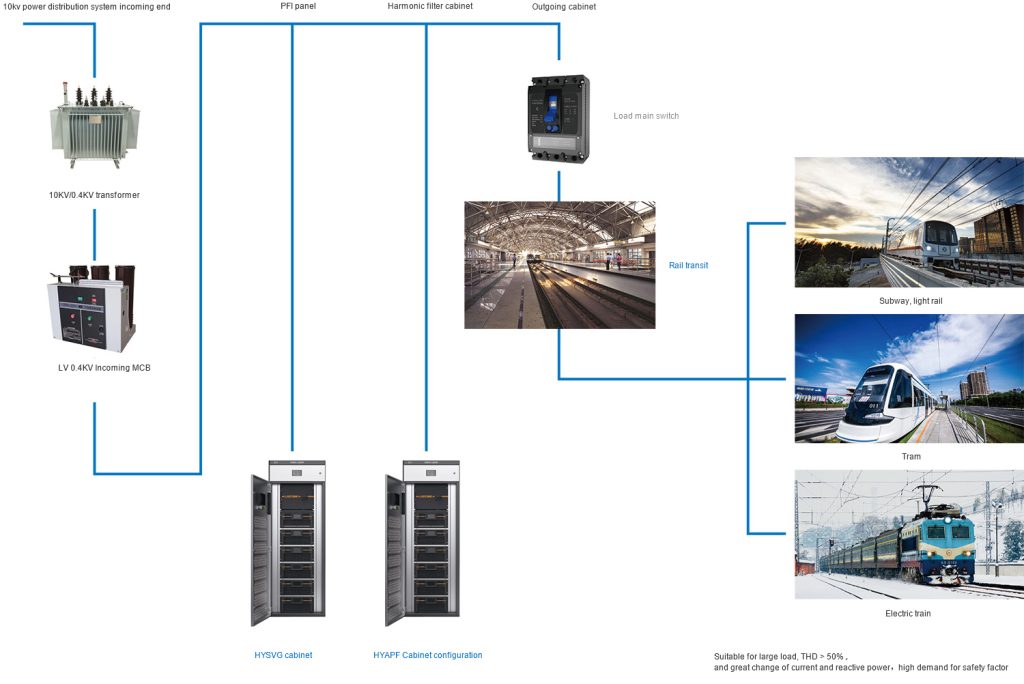
To solve these issues, Elcosine Active Power Filter (APF) devices are deployed:
Dynamic Harmonic Filtering: APFs generate compensating currents with equal amplitude but opposite phase angle to detected harmonics, effectively canceling them out and purifying the grid.
Superior to Passive Filters: Unlike traditional passive filters, APFs provide dynamic real-time harmonic compensation, adapt to load changes, and are not prone to resonance.
Reactive Power Compensation: Simultaneous compensation of inductive and capacitive reactive power ensures a stable power factor and efficient operation.
Achieved Results
Improved Reliability: Reduced equipment failure rates across rail transit power systems.
Grid Stability: Significant improvement in voltage waveform quality and overall grid safety.
Energy Efficiency: Lower transformer and line losses, reducing operational costs.
Sustainable Transit Operations: Ensures reliable and safe traction power for urban rail transit, aligned with modern energy-saving and environmental protection goals.
Scheme drawing reference